
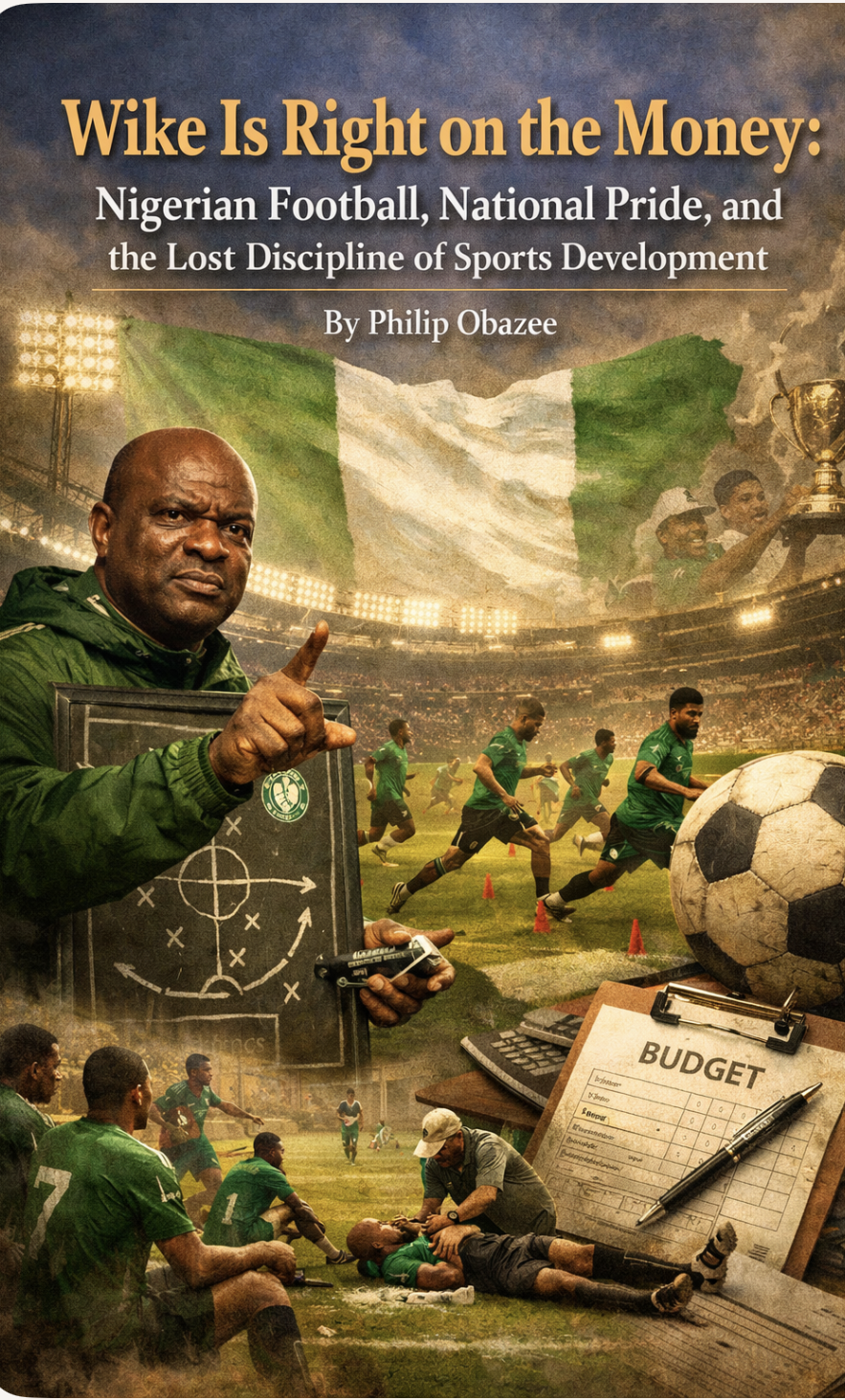
Previously published on VANGUARD Newspaper of June 25, 2026.
Wike is right on the money. Nigeria’s failure to qualify for the World Cup is not a small football inconvenience. It is a national embarrassment, a civic disappointment, and a painful reminder that talent without organization is waste.
I will say plainly what the rest of this article will defend: the frustration Wike gave voice to is correct, but the reason it is correct is not the reason most people reach for. The Super Eagles did not fail because Nigeria ran out of talent. They failed because Nigeria runs a football system that leaves outcomes hostage to luck — brilliant when the dice fall well, humiliating when they do not. The anger is justified. The diagnosis behind the anger usually is not. This article is an attempt to repair the diagnosis without lowering the temperature of the feeling, because the feeling is honest and the country is entitled to it.
For Nigerians at home, the Super Eagles are more than a football team. For Nigerians abroad, they are even more than that. They are a bridge to home. They are memory, identity, pride, and emotional citizenship. When the Super Eagles play on the world stage, Nigerians in London, Houston, Johannesburg, Toronto, Atlanta, Berlin, and Philadelphia suddenly feel the green-white-green more intensely. The distance between homeland and diaspora collapses. A goal becomes more than a goal; it becomes a shout of belonging.
That is why Wike’s frustration resonates. Nigerians are not angry simply because eleven men failed to win enough matches. They are angry because football is one of the few national institutions that can still make Nigerians suspend their differences and gather under a shared emotional roof. In a country divided by politics, ethnicity, religion, class, region, and distrust, football still has the power to say: for ninety minutes, we are one people.
So, when Nigeria misses the World Cup, something larger than sport is lost. A platform of pride is lost. A moment of unity is lost. A chance for national joy is lost. A country already tired from economic hardship, insecurity, political quarrels, and institutional disappointment is denied one of the few rituals that can still make citizens smile together.
And the timing makes the wound deeper. The 2026 World Cup was expanded to forty-eight teams, and with that expansion Africa’s direct allocation rose to nine places — the widest gate the continent has ever been offered. The bar was lower than it had ever been in the history of the competition, and Nigeria still did not clear it. That is the detail that should sober every honest Nigerian. We did not fail to climb a wall that was raised against us. We failed to walk through a door that was deliberately widened.
The tragedy is not that Nigeria lacks talent. That would be easier to accept. The tragedy is that Nigeria has enormous talent and still fails to organize it properly. We have the players, the passion, the history, the athletic capacity, the street football culture, the diaspora pool, and the global name recognition. What we lack is the disciplined architecture that converts talent into sustained achievement.
That is the issue. Nigerian football is not suffering from lack of raw material. It is suffering from poor organization.
To outsiders, football may look like entertainment. To Nigerians, it is part of national psychology. It carries memory. It carries emotion. It carries pride. It carries grievance. It carries the strange capacity to make a wounded people believe again, even if briefly.
Those of us in the diaspora understand this deeply. We may live in America, Europe, or elsewhere, but the Super Eagles remain one of the most visible symbols of home. One can live abroad for decades and still feel a sudden childhood memory return when Nigeria walks onto a football field. The jersey, the anthem, the flair, the restless movement, the nervous energy of the match — all of it carries something deeply Nigerian.
Football is one of the few spaces where Nigerians abroad do not need to explain themselves. We simply gather, watch, shout, argue, pray, and remember. In that moment, the country is not a political problem on television or a headline about insecurity. It is a living identity.
This is why failure hurts. It is not only the players who miss the World Cup. Nigerians miss the World Cup. Nigerian children miss seeing their country on the global stage. Nigerian immigrants miss the chance to walk proudly into offices, restaurants, schools, and neighborhoods with the Super Eagles on their chest. Nigerian families miss the chance to gather around the television and introduce younger generations to the emotional inheritance of Nigerian football.
Sport performs a symbolic function that politics often cannot. Politicians divide. Football can unite. Parties accuse. Football can gather. Elections produce bitterness. Football can produce collective joy. That does not mean football is pure or free from politics. Far from it. But football has a unique civic power. It can compress difference into shared emotion.
That is why Nigerian football must be treated as a national institution, not simply a recreational activity.
Nigeria is not a marginal football country. That is what makes the World Cup absence so painful. This is not a nation with no football pedigree. Nigeria has appeared on the global stage, produced memorable players, won Olympic gold, competed fiercely in African football, and supplied talent to clubs across Europe and beyond. Nigerian names are recognized in world football. Nigerian style is recognized. Nigerian possibility is recognized.
That is precisely the problem. The world knows Nigeria has footballing capacity. Nigerians know it too. So, when the Super Eagles fail to qualify, the failure cannot be explained away as lack of talent. It becomes a failure of systems.
A small country with limited football history may miss the World Cup and move on. Nigeria cannot do that so easily. Nigeria carries expectation. It carries football memory. It carries continental weight. It carries the burden of representing not just itself but a certain African athletic confidence.
The painful fact is that Nigeria should not be watching the World Cup from outside. It should be participating. It should be competing. It should be presenting its talent to the world. It should be giving its citizens a reason to gather around pride rather than complaint.
The World Cup is not just another tournament. It is the largest stage in global sport. It is where nations display themselves. For developing countries especially, it can become a form of symbolic diplomacy. A strong World Cup showing tells the world that a country exists not as a place of crisis, but as a place of energy, talent, discipline, and possibility.
Nigeria missing that platform matters.
It matters because young Nigerians lose a visible dream. It matters because the diaspora loses a global occasion to rally around the homeland. It matters because the Nigerian brand loses an opportunity for positive visibility. It matters because citizens are denied a rare source of legitimate national joy.
A country under stress needs symbols of competence. The Super Eagles should be one of those symbols. Instead, their absence has become another reminder of the gap between Nigerian potential and Nigerian performance.
Nigeria is one of the most naturally gifted sporting countries in the world. That is not empty praise. It is visible in football, athletics, basketball, boxing, wrestling, weightlifting, table tennis, and increasingly in global diaspora sport. Nigerian bodies, minds, and competitive instincts show up everywhere.
In football specifically, Nigerian talent is scattered across local academies, European clubs, informal playing fields, secondary schools, diaspora communities, and street corners where children learn technique before they ever meet a formal coach. The Nigerian player often carries flair, strength, improvisation, speed, and competitive stubbornness. These are not minor qualities. They are footballing assets.
But talent is raw material. It must be found, trained, disciplined, protected, and organized. Without structure, talent leaks. It migrates. It underperforms. It becomes inconsistent. It appears in flashes rather than in sustained institutional achievement.
This is the Nigerian problem in miniature. We are blessed with people, but we underinvest in systems. We celebrate talent after it succeeds abroad, but we fail to build the machinery that discovers and develops it at home. We praise the individual genius but neglect the institutional environment that makes genius repeatable.
A serious football nation does not wait for miracles. It builds pipelines. It identifies players early. It trains coaches. It maintains pitches. It organizes school competitions. It builds medical systems. It tracks performance data. It protects young athletes from exploitation. It links local development to professional pathways. It treats player welfare as part of performance. It builds continuity between youth teams and the senior national team.
Nigeria cannot keep relying on spontaneous brilliance. Spontaneous brilliance may win a match; it does not build a football civilization.
The central problem of Nigerian football is not talent scarcity. It is talent mismanagement.
Talent without structure is waste. Talent without discipline becomes inconsistency. Talent without coaching becomes raw energy. Talent without administration becomes frustration. Talent without long-term planning becomes accidental success followed by predictable decline.
But I want to be more precise about what “waste” means here, because the loose version of this claim hides the very thing that makes it true. If you say only that weak structure produces bad results, an obvious objection arises: Nigeria has qualified for the World Cup many times with roughly the same threadbare apparatus we are now lamenting. A constraint that has always been weak should, on the lazy version of the argument, produce consistent failure. It does not. It produces oscillation — qualification, then humiliation, then qualification again, then another collapse. Anyone who has followed the Super Eagles for thirty years knows this rhythm of hope and disappointment intimately.
So, the honest argument is not that weak structure lowers our results. It is that weak structure widens the spread between our best and our worst. A well-built football nation raises the floor. Its weakest plausible team is still competent, still organized, still hard to beat, because the system underneath the eleven players guarantees a baseline that does not depend on whether a generational talent happens to be available that year. A poorly built football nation has no floor. Its outcomes swing violently around an average it cannot rely on, because everything rests on whether individual brilliance shows up in sufficient quantity at exactly the right moment. When it does, we qualify and call ourselves a football powerhouse. When it does not, we miss a forty-eight-team World Cup and call it a tragedy. Both are the same system. The system did not change between the triumph and the disaster. Only the luck did.
That is what waste means. Waste is not the absence of good results. It is the surrender of good results to chance. A structured nation converts talent into something close to a guarantee. An unstructured nation converts the same talent into a gamble it loses too often. Our problem is not that we never win. Our problem is that we cannot decide to win, because we have built nothing that makes winning repeatable.
This is where Nigeria must be honest. We love the emotional drama of football, but we have not always respected the institutional science of football. We want victory, but we often neglect the foundations of victory. We want world-class players, but we tolerate poor youth systems. We want tactical maturity, but we underinvest in coaching education. We want physical excellence, but we neglect sports medicine, nutrition, recovery, and player monitoring. We want national pride, but we allow administrative confusion to weaken preparation.
Modern football is no longer only about passion. It is about organization. It is about scouting networks, analytics, sports psychology, medical support, tactical continuity, player development, commercial management, and institutional discipline. The countries that succeed repeatedly do not succeed by accident. They build systems that make success more likely.
Nigeria too often treats football as if emotion can substitute for structure. It cannot.
The national team should be the apex of a pyramid. Beneath it should be school football, local leagues, state competitions, academies, youth tournaments, coaching programs, player databases, medical systems, and performance evaluation. If the pyramid is weak, the apex will wobble.
This is why the disappointment over the Super Eagles should not be wasted on blame alone. Blame is easy. Reform is harder. The real question is not simply who failed in the last qualification cycle. The real question is why Nigerian football remains so dependent on individual brilliance rather than institutional reliability.
Until that question is answered, the country will continue to oscillate between hope and disappointment — and now we know precisely why. Oscillation is not bad luck. It is the signature of a system with no floor.
It is worth pausing to ask what could disprove the argument I am making, because an argument that cannot be wrong is not worth much. If I claim that Nigeria has abundant talent, and I also claim that talent without structure is waste, then I have built myself a trap in which I can never lose. Every Nigerian success becomes proof that the talent shone through; every Nigerian failure becomes proof that the structure failed. Heads I win, tails I win. That is not analysis. That is a closed circle.
So, let me state the commitment honestly. My argument would be in serious trouble if we could find countries with raw football talent comparable to Nigeria’s, who built serious developmental systems, and who nevertheless continued to fail at the same rate Nigeria does. If structure made no difference — if well-organized football nations swung between glory and collapse exactly as we do — then the structural account would collapse and we would have to look elsewhere for our explanation, perhaps to something fixed and beyond our control.
But that is not what the evidence shows, and the most powerful evidence is not European at all. It is African, which matters, because the easiest way to dismiss this entire argument is to whisper that systems are a luxury of rich, cold, distant nations with no relevance to our reality.
Consider Morocco. At the 2022 World Cup, Morocco became the first African nation ever to reach the semifinals of the tournament — not as a fluke of one golden generation, but as the visible apex of years of deliberate institutional investment. The Moroccan federation built a national football academy, funded development seriously, imported and retained coaching expertise, and constructed continuity between its youth structures and its senior team. The semifinal did not fall from the sky. It was manufactured, in the best sense of the word, by a country that decided to build a floor under its talent so that the ceiling could rise.
Consider Senegal, African champions, a team that combined a deep diaspora talent pool with administrative seriousness and turned it into a continental title rather than a permanent promise. Senegal did what Nigeria keeps failing to do: it organized its gifts.
These examples close the door on the comfortable excuse. Nobody can claim that structure only works for Europeans, because the two clearest recent demonstrations that organization converts African talent into repeatable African achievement are sitting right beside us on the same continent, drawing from the same global diaspora, facing the same skepticism Nigeria faces, and answering it with results. Morocco and Senegal are not richer than Nigeria in talent. They are richer than Nigeria in system. That is the whole difference, and it is a difference we could choose to erase.
This is the empirical backbone the emotional argument needs. Without it, “build systems” is a slogan. With it, “build systems” is an inference from cases we can see, study, and copy.
Here I must introduce a distinction the football conversation in Nigeria almost always blurs, because blurring it leads to bad spending and false expectations.
When we talk about “developing Nigerian football,” we are actually talking about three different goals that wear the same jersey but do not obey the same logic. The first is elite high performance: producing roughly two dozen world-class players, fit and coordinated enough to win matches at the very top of the global game. The second is mass participation: getting millions of Nigerian children into organized, disciplined, healthy sporting life, most of whom will never play professionally and do not need to. The third is diaspora identity and national pride: the emotional return that football gives to a scattered, anxious, proud people who need symbols of competence.
These three are related, but they are not the same investment, and at the margin they can even compete for the same naira. The money that builds a centralized elite academy for fifty gifted teenagers is not automatically the money that funds ten thousand school competitions across the federation, and the money that does either is not the money that simply buys a better-run senior national team and a reliable diaspora scouting operation. The pyramid metaphor is comforting because it suggests that all of this is one smooth structure, that mass participation at the base automatically produces elite excellence at the top, and that one budget serves all three goals at once. Reality is more stubborn. A wide base improves the odds of finding elite talent, but it does not guarantee the elite machinery that finishes the job, and a gleaming elite academy does nothing for the social health of a town that has no field for its children.
I raise this not to discourage ambition but to discipline it. A country can pursue all three goals — it should — but only if it admits they are three goals, prices them separately, and stops pretending that a single gesture, a single stadium, a single federation reform, will deliver all of them simultaneously. Most Nigerian sports policy fails precisely here: it announces one project and expects it to pay three different dividends, and then it is surprised when it pays none of them well.
There is a harder honesty still, and I owe it to the reader because the rest of this article asks the Nigerian state to spend.
Nigeria is not, in the end, a poor nation. It is a constrained one — a country whose problem is less the absence of resources than the chronic misallocation and capture of the resources it has. Every naira spent on a football academy, a school competition, or a state sports program is a naira not spent on a clinic, a classroom, or the security of a road that is presently unsafe to travel. To argue for sports investment without admitting this is to argue dishonestly, and the reader deserves better than a wish list that pretends the budget is infinite.
So let me make the argument properly rather than skip the line. The case for sport is not that it is more important than health or education or security. It is that grassroots sport is unusually cheap relative to the social return it generates, and that the return it generates overlaps with the very things the rival budgets are chasing. A maintained field, a trained coach, an organized school league, a Saturday tournament — these cost very little compared to a hospital wing or a brigade, and yet they purchase a measure of youth discipline, public health, community cohesion, and absorbed restless energy that the security budget would otherwise have to chase with far more expensive instruments after the fact. A young man inside an organized team on Saturday is a cheaper public good than the same young man left to idleness and recruitment. That is the argument. Not that sport outranks the alternatives, but that at the low end of the cost curve its civic yield is high enough to earn its place in a constrained budget on the merits — and that we should be willing to defend it on those merits rather than on sentiment alone.
This is the honest foundation for everything that follows. I am not asking Nigeria to love football more than it loves its sick or its schoolchildren. I am asking Nigeria to recognize that a small, well-targeted investment in organized sport pays back in coin the other budgets are already trying to buy.
I am a product of the Ogbemudia era in Bendel State (now Edo and Delta States), and I can testify to something important: sport can be used to engineer social order.
That phrase may sound ambitious, but it is true. In the Bendel of that period, sports were not treated merely as games. They were instruments of discipline, identity, ambition, civic confidence, and youth development. Young people saw sports as a path toward recognition, structure, and self-belief. Schools, communities, and public institutions understood that athletic excellence could serve a larger social purpose.
Ogbemudia understood that sports could bring people together. It could redirect youthful energy. It could build pride in place. It could produce heroes. It could create healthy competition. It could give communities a sense of shared achievement. It could make young people believe that discipline mattered.
That lesson should not be lost.
I offer this as testimony, and I want to be clear about what testimony can and cannot do. It is an illustration, not a controlled experiment. The Bendel of that era enjoyed conditions that no longer hold — oil-boom public funding, a smaller and younger population to organize, a different relationship between citizen and state. I cannot prove from my own memory that Ogbemudia’s sports policy alone produced the order I remember, because too many other things were changing at once. What I can say is that the mechanism is plausible, that I watched it work in front of me, and that it coheres with the harder, comparative evidence from Morocco and Senegal that organized investment converts youthful athletic energy into something durable. Personal memory cannot carry the weight of proof. It can light the way toward a hypothesis worth funding.
The point is not nostalgia for a past that cannot be mechanically recreated. Nigeria has changed. Bendel State has changed. Sports have changed. The global football economy has changed. But the underlying principle remains valid: a society that organizes sports well gives its young people a constructive arena for ambition.
Sports can do what lectures cannot. It can teach discipline without preaching. It can teach hierarchy without humiliation. It can teach teamwork without theory. It can teach resilience through loss and humility through victory. It can teach young people that talent requires training, that effort matters, that rules matter, and that excellence is earned.
In a country struggling with youth frustration, insecurity, unemployment, and social distrust, sports should not be treated as a luxury. It should be treated as part of social policy.
Nigeria needs to recover the social function of sports.
A young person who belongs to a team learns more than how to kick a ball. He learns timekeeping, obedience to rules, physical discipline, respect for coaching, cooperation with peers, emotional control, and the relationship between effort and reward. A community with organized sports has less idle energy and more constructive competition. A school with sports has another pathway for students who may not shine only in the classroom. A state with serious sports policy creates pride, events, facilities, jobs, and identity.
Sports cannot solve all social problems. That would be an exaggeration. But sports can help shape behavior. It can absorb energy that might otherwise drift into disorder. It can create aspiration in places where young people feel forgotten. It can produce belonging in communities fractured by distrust.
This is especially important in Nigeria, where millions of young people need structure, hope, and credible pathways. Not every child will become a professional athlete. That is not the point. The point is that organized sports can help create healthier citizens, disciplined students, stronger communities, and more confident youth. This, notice, is the mass-participation goal, not the elite-performance goal — and it is the one with the strongest claim on a constrained budget, precisely because its returns are broad, cheap, and civic rather than narrow, costly, and glamorous.
A country does not need every participant to become a star before sports policy becomes valuable. The broad social return lies in participation, discipline, health, identity, and community cohesion.
Football, because of its popularity, is the natural entry point. But the logic extends beyond football. Athletics, basketball, boxing, wrestling, table tennis, volleyball, swimming, tennis, and women’s football all have developmental value. They can widen opportunity. They can deepen national pride. They can provide alternatives to idleness and despair.
Nigeria should not treat sports only as a medal factory. It should treat sports as a civic institution.
If Nigerian football is to recover, governance must be professionalized.
This means the institutions responsible for football must become more transparent, technically competent, accountable, and future-oriented. Football administration cannot be treated as a patronage arena. It cannot be reduced to travel allowances, crisis management, political appointments, and last-minute scrambling before major tournaments.
A serious football country plans. It does not improvise endlessly.
Nigeria needs a coherent football development architecture. That architecture should include transparent administration, technical planning, youth scouting, school competitions, academy regulation, coach development, sports medicine, player welfare, data systems, and proper preparation for international competitions. This architecture is, in the language of the earlier argument, simply the floor — the institutional baseline that guarantees a competent team even in a year when no generational talent appears. Building it is how a nation converts the gamble into the guarantee.
The Nigeria Football Federation, state football associations, clubs, schools, private academies, sponsors, and government agencies must be made to function as parts of one ecosystem rather than isolated and often conflicting units. The system must know where talent is, how talent is moving, who is developing it, and how the best players are being prepared.
Coaching deserves special attention. Too often, African football debates focus on players and ignore coaching systems. A country with talented players but weak coaching pipelines will remain inconsistent. Coaches shape decision-making, tactical discipline, emotional maturity, and game management. Nigeria needs better coach education at every level, not only at the national team level.
Player welfare also matters. When players feel disrespected, poorly treated, or administratively neglected, performance suffers. Professionalism is not only about what happens on the pitch. It includes travel, accommodation, medical care, payment clarity, communication, preparation, and respect.
If Nigeria wants world-class performance, it must provide world-class seriousness.
The global football economy has changed. Nigeria must change with it. And here, at what most readers will treat as a side issue, sits what I consider the sharpest problem of all — sharp enough that I want to slow down and look at it directly, because it reveals the deepest reason our chaos costs us.
Many young Nigerians are now born, raised, or trained abroad. Some have multiple national options. They may love Nigeria emotionally but also evaluate their professional futures carefully. Sentiment alone will not secure their loyalty.
Consider what such a young player is actually doing when he chooses a country. He is making a calculation, whether or not he uses that word. He is weighing the trajectory of his career, the probability that a given nation reaches major tournaments, the quality of its coaching, the stability of its team, the reliability of its administration, and the dignity with which he expects to be treated — and somewhere in that weighing sits his affection for the country of his parents. Sentiment is real, and it carries weight. But it is one term in the calculation, not the whole of it. He is choosing the federation that offers him the best expected future, with national feeling as a thumb on the scale rather than the scale itself.
This reframes the entire problem. Nigeria’s administrative chaos is not simply an embarrassment; it is a discount applied to the value of choosing Nigeria. Every story of unpaid bonuses, every shambolic camp, every fixture nearly missed because of a logistics failure, lowers the expected value of the green-white-green in the mind of exactly the player we are trying to recruit. Sentiment must overcome that discount. And as the discount grows, there comes a point where even genuine love is not enough to clear it — where a young man who would be proud to wear our colors quietly decides that pride is not worth the professional cost, and chooses the country that will simply behave like a serious employer.
What we are dealing with, in plain terms, is a problem of trust. A nation’s word to a young player is only as good as its reliability, and reliability is something you build over years and destroy in an afternoon. Nigeria cannot credibly promise a dual-national talent that it will treat him well, because nothing in its administrative behavior makes that promise believable. The sentiment is sincere; the institution is not trustworthy; and the player, who is not a fool, prices the gap. This is why professionalism is not a luxury layered on top of recruitment. It is recruitment. The system that pays players on time and runs camps competently is the same system that makes patriotism a rational choice rather than a sacrifice.
This requires professionalism, then, in the deepest sense. A young player choosing between countries will look at coaching quality, team stability, tournament prospects, administrative reliability, player treatment, and career impact. If Nigeria appears chaotic, sentimental appeals may not be enough — and we should stop being surprised, and stop being wounded, when they are not.
The diaspora should be treated as part of Nigeria’s football asset base. But that asset must be managed with seriousness. Nigeria needs structured scouting abroad, early relationship-building with families, clear communication with dual-national players, and a reputation for professionalism — which is to say, it needs to lower the discount it currently imposes on its own flag.
At the same time, Nigeria must not neglect homegrown talent. The diaspora is an addition, not a substitute. The country must develop local players with equal seriousness. A healthy national team should draw from both streams: the local pipeline and the global diaspora.
The larger point is simple: Nigerian identity travels. It travels in names, families, food, language, rhythm, memory, and athletic instinct. Many young Nigerians abroad may not carry the green-white-green outwardly every day, but something of Nigeria remains in them. The task is to build a football system worthy of that inheritance — worthy enough that choosing it is not a sacrifice a young man makes against his own interests, but a decision that serves both his heart and his future.
The Super Eagles should be the most visible part of a broader national sports strategy. They should not stand alone.
Nigeria needs a serious sports development plan that connects schools, states, clubs, private sponsors, health policy, youth development, local governments, universities, and national federations. Sports should be linked to education, employment, social order, public health, tourism, branding, and national identity. But — and the earlier distinction now does its work — that plan must be honest about which of its three goals each program serves. A school-competition program is mass participation and social order; it should be judged by reach and health and discipline, not by how many Super Eagles it produces. An elite academy is high performance; it should be judged by the world-class players it graduates, not by how many children it entertains. A diaspora scouting operation and a competent federation are about the senior team and national pride directly. Confusing these is how Nigeria spends money on one thing and waits forever for the dividend of another.
A serious national sports strategy would ask practical questions.
Where are the school sports competitions? Where are the community fields? Who maintains them? How are young athletes discovered? How are coaches trained? How are girls encouraged to participate? How are athletes protected from exploitation? How are state competitions funded? How are private sponsors involved? How are facilities used after they are built? How is data collected? How is success measured? And against which of the three goals is each program being measured, so that we stop grading a participation program by an elite yardstick and calling it a failure?
These questions matter because Nigeria has too often built facilities without building systems. A stadium without programming is a monument. A field without maintenance is decay waiting to happen. A competition without continuity is an event, not a development strategy.
The goal should not be occasional glory. The goal should be repeatable excellence. And by now the reader knows precisely what “repeatable” means: it means an outcome that does not depend on luck, a floor high enough that we no longer hold our breath every qualification cycle waiting to discover which version of ourselves will show up.
That means continuity. It means planning beyond one minister, one governor, one federation president, one coach, or one tournament. It means sports development must survive political turnover. It means institutions must matter more than personalities.
State governments must return to the center of sports development.
In a federation, sports cannot be built only from Abuja. Talent is local before it becomes national. A player is discovered in a street, school, academy, town, village, or state before he becomes a Super Eagle. If states do not build, the national pool weakens.
The Bendel example matters here. It shows that state-level seriousness can produce national impact. A governor who understands sports can build facilities, support school competitions, fund coaches, create state leagues, encourage private sponsorship, and make sports part of youth policy. And because grassroots sport sits at the cheap end of the cost curve, this is a level of investment a state can actually afford to sustain — which is exactly why the state, not only the federal centre, is where the social return is most realistically captured.
Every Nigerian state should ask itself what sport it wants to be known for. Some states may have football depth. Others may have athletics, wrestling, boxing, basketball, swimming, weightlifting, or table tennis potential. The point is not for every state to do everything. The point is for each state to develop a coherent sports identity and pipeline.
Sports should be part of governance. It should not be reduced to ceremonial appearances when athletes win medals. Governors should see sports as youth development, public health, social order, tourism, and economic activity. A vibrant sports culture creates jobs for coaches, trainers, medical staff, facility managers, vendors, transporters, broadcasters, and event organizers.
If Nigeria wants better national teams, it must begin with better state systems.
Wike is right to be unhappy. Many of us are unhappy. Every Nigerian well-wisher in the United States and across the world feels the pain of this World Cup absence.
But unhappiness must become organization. Anger must become reform. Disappointment must become planning. Otherwise, we will repeat the same cycle: outrage, blame, temporary promises, weak reform, another failure, and another round of national lamentation. That cycle, remember, is not a run of bad luck. It is the predictable behavior of a system with no floor, and it will continue producing the same oscillation for as long as we leave the floor unbuilt.
Nigeria has the talent. That is not in doubt. Nigeria has the passion. That is not in doubt. Nigeria has the football history. That is not in doubt. What Nigeria needs is discipline: disciplined administration, disciplined youth development, disciplined state investment, disciplined coaching, disciplined player welfare, and disciplined long-term planning. Morocco proved an African nation can build that discipline and reach a World Cup semifinal with it. Senegal proved an African nation can build it and win a continental crown. The proof is not theoretical, and it is not foreign. It is sitting beside us, and it is achievable.
The Super Eagles can again become a source of national joy. They can again give Nigerians at home and abroad a reason to gather proudly. They can again serve as one of the great symbols of Nigerian confidence. But this will not happen by wishful thinking.
It will happen when Nigeria treats sports as nation-building.
Football can build more than athletes. It can build confidence. It can build unity. It can build memory. It can build civic pride. It can give young people a constructive path. It can remind a divided people that they still belong to one country.
That is the lesson Nigeria must recover. The Ogbemudia era showed many of us what sports could do when leadership understood its social power. The present disappointment should force the country to remember that lesson.
Nigeria must not simply mourn the Super Eagles’ absence. It must rebuild the system that will make such absence less likely in the future — which is only another way of saying it must build, at last, a floor beneath its own talent, so that the question of whether Nigeria appears on the world stage stops being a matter of luck and becomes, finally, a matter of choice.
The joy can return. But first, the organization must return.
_____
Philip Obazee retired as a managing director and head of derivatives from Macquarie Asset Management – a global asset management company with an office in Philadelphia, PA, USA, and currently, he is the founder and chief executive officer of Polymetrics Americas Research.
RETURN

Wike Is Right on the Money: Nigerian Football, National Pride, and the Lost Discipline of Sports DevelopmentPreviously published on VANGUARD Newspaper...
The Blessing Has Been Given; The Stewardship Remains- A Sermon for the Thirteenth Sunday in Ordinary Time -My dear brothers and sisters in Christ,I ag...

AI Can Cross Disciplines. It Still Can’t Replace Expert Judgmentfirst published on Substack on April 28, 2026Large language models (LLMs) have becom...
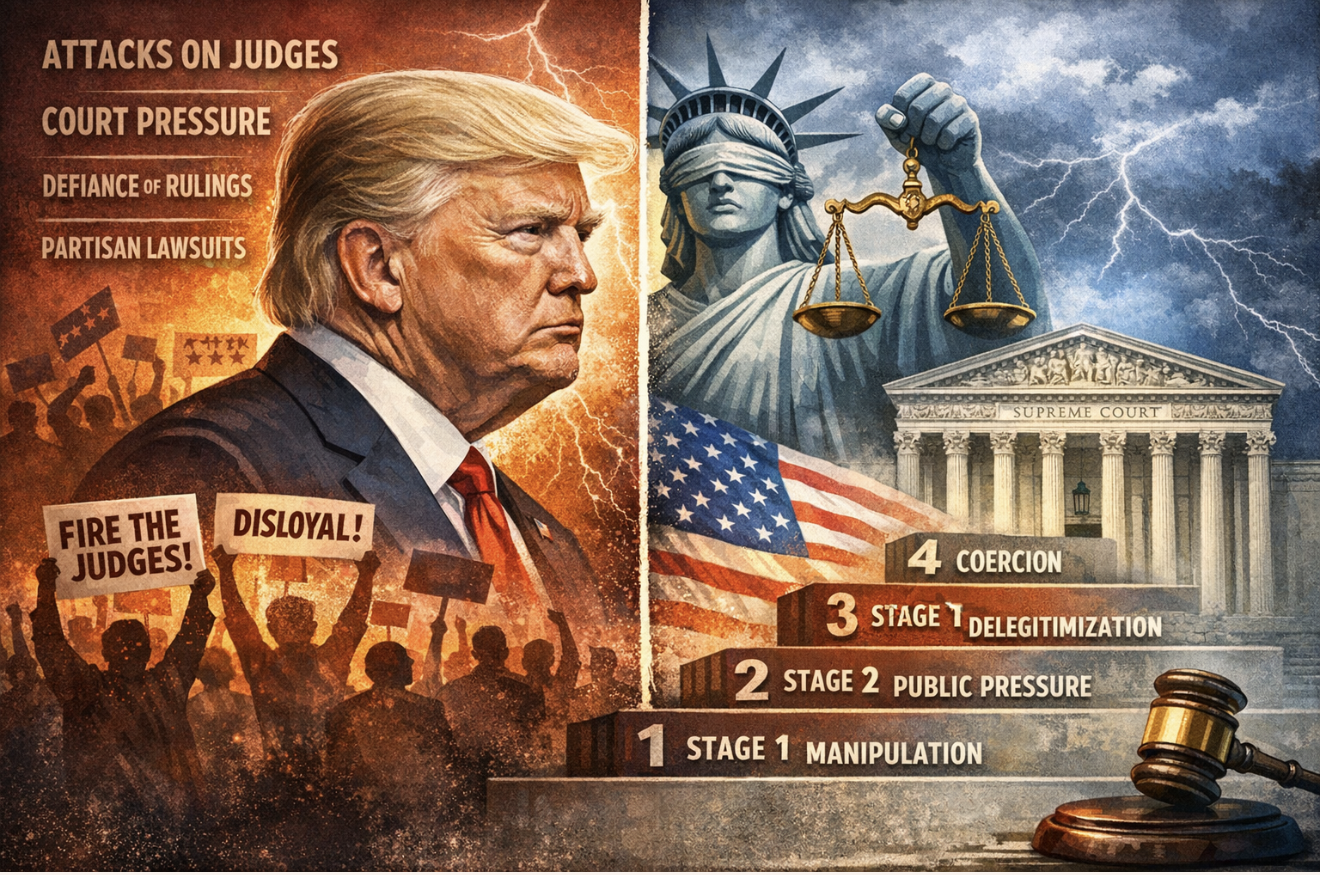
Intimidating The Judiciary: Trump and A Global History of Executive Pressure on Supreme Courts- From Washington to Berlin to Budapest, and the warning...

From the Powell Memo to Project 2025: How a 1971 Corporate Strategy Became a Global Template for PowerIn August 1971, a corporate lawyer named Lewis P...




General / Jun 27, 2026
Wike Is Right on the Money: Nigerian Football, National Pride, and the Lost Discipline of Sports DevelopmentGeneral / Jun 28, 2026
The Blessing Has Been Given; The Stewardship Remains - A Sermon for the Thirteenth Sunday in Ordinary Time -Social & Political Issues / Apr 28, 2003
A Preliminary Forensic Analysis of INEC’s Website So FarSocial & Political Issues / Jan 06, 2006
A Politician And The Legacy Bequeathed To The Society© 2026 Segun Toyin Dawodu | All rights reserved